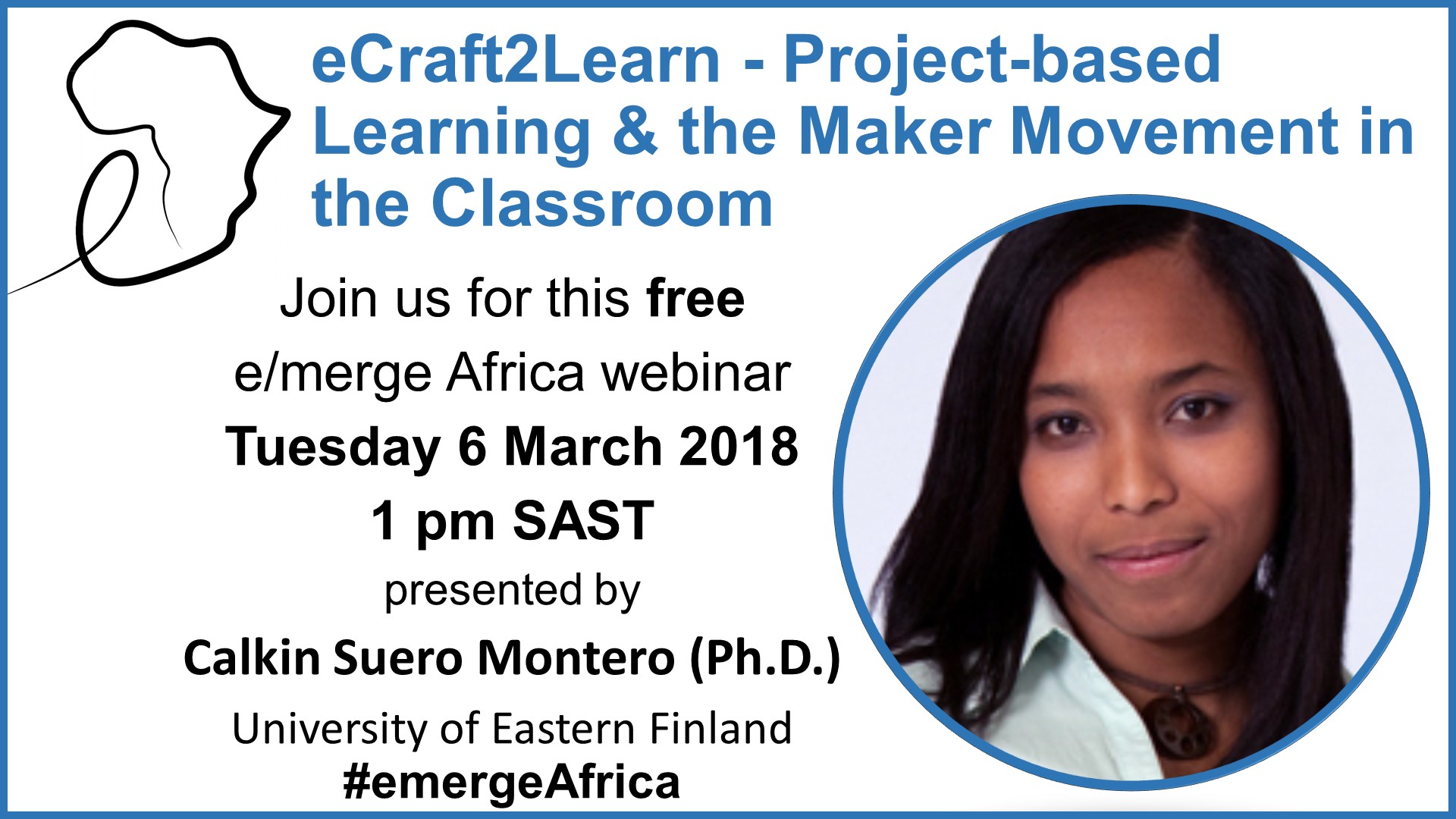
6 March: eCraft2Learn – Project-based Learning and the Maker Movement in the Classroom

Presenter: Calkin Suero Montero (Ph.D.), University of Eastern Finland

Time and Date: Tuesday 6 March 2018, 1 pm SAST

Time converter at worldtimebuddy.com

Most uses of technologies in education and training today do not support 21st-century learning skills. In many cases, new technologies are simply reinforcing old ways of training and learning in current school settings and very often they are introduced according to a narrow perception as being suitable only for talented youth or only for Science-, Maths- or Engineering-oriented majors. Current developments call for a move from this elitism to the recognition that fluency with making technologies represents knowledge and skills valuable for every citizen.

The maker movement is a trend in which individuals or groups of individuals create (and market) products that are recreated and assembled using recycled materials including  electronic, plastic, silicon and virtually any raw material. Digital fabrication, complementary, is a process that joints design with production through the use of tools such as 3D modelling (computer-aided design) software and 3D printing. Nowadays, several studies assure that digital fabrication and making technologies, if coupled with proper learning methodologies such as Constructivism can provide learning experiences that promote young people’s creativity, critical thinking, teamwork, and problem solving skills, which are essential and necessary in the workplace of the 21st century.

The eCraft2Learn project will research, design, pilot, and validate a learning ecosystem for making computer-supported artefacts in both formal and informal learning contexts. The eCraft2Learn project seeks to establish digital fabrication and making as 21st century learning activities in formal and informal educational contexts; and to encourage a paradigm shift in technology education from black box and silo products – avoiding pre-programmed and pre-fabricated solutions which appear as black boxes – to the white box paradigm, so that learners change roles from consumers of digital technology to designers and makers of transparent problem solving artefacts.

In this webinar, Dr. Calkin Suero Montero will:

  • Explain maker movement and digital fabrication
  • Engage us in considering what this means for classrooms in educational contexts more broadly (formal and informal, school and university)
  • Share PBL approaches that support 21st century skills through digital fabrication and making from the eCraft2Learn project
  • Explain what a paradigm shift in technology education entails and why it is necessary
  • Tips educators need to consider for using making in the classroom

This seminar has ended – for recording and resources presented please refer to the Facebook event page for this event

Dr Calkin Suero Montero obtained her PhD in computer science at School of Information Science and Technology, Hokkaido University, Japan. She works at the intersection of human-computer interaction, affective computing and ICT for development within educational contexts. She has ample experience working in multicultural environments on the deployment of innovative solutions to societal challenges with a particular focus on the application of educational technologies. She is Senior Researcher and H2020 eCraft2Learn Project lead investigator and coordinator at the School of Computing, University of Eastern Finland.
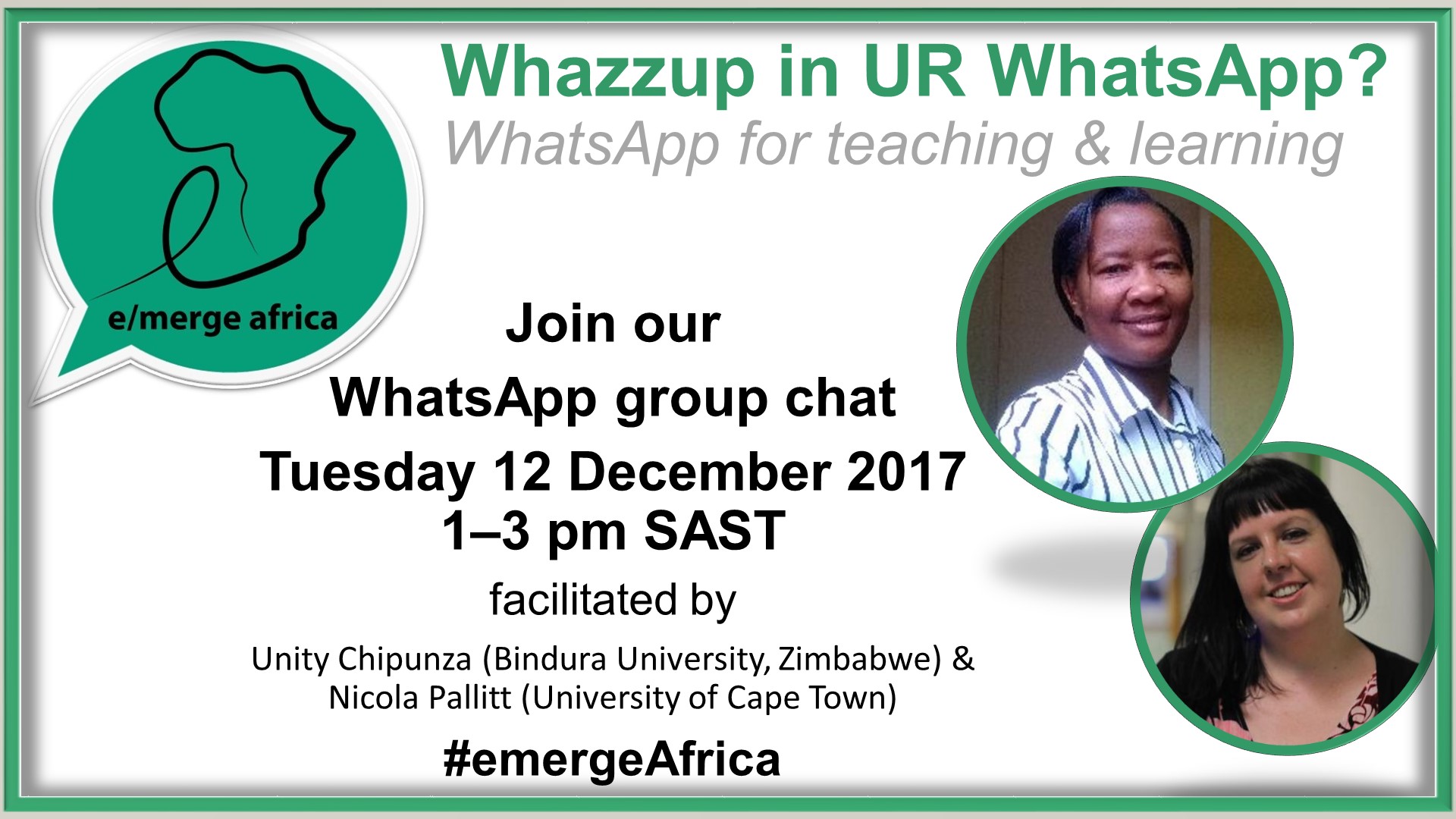
 

Whazzup in UR WhatsApp?

WhatsApp is being used across African Higher Education Institutions for teaching and learning activities in a variety of innovative ways. Join Unity Chipunza (Bindura University, Zimbabwe) and Nicola Pallitt (University of Cape Town) as they share their experiences of using WhatsApp with students in their contexts and facilitate discussion. We want to hear from you too – we invite you to share your practices, tips, challenges and successes. Tell us what’s up in your WhatsApp:)

Tuesday 12 December 2017 at 1 – 3 pm SAST

Time converter at worldtimebuddy.com

Before the chat:

  1. You are invited to join Whatsapp group ahead of time as you will not be able to access the discussion and media shared in the group before you joined https://chat.whatsapp.com/LGlZMP08741EZIjnkQpabH  Joining this group will be your way of signing up.
  2. Please view the introductory stimulus here:

During the chat:

As WhatsApp can be quite a messy space for discussion. Conversation will happen in stages, guided by 1 question at a time:

Q1: How have you been using WhatsApp with students in your context? (first 30 mins of the chat)

Q2: What motivated your choice to use WhatsApp? (15 mins)

Q3: What do you think your students learn through interaction with their peers and/or lecturers in WhatsApp groups for their courses? (15 mins)

Q4: What are some of the challenges you and your students encounter when using WhatsApp with students? (15 mins)

Q5: Do you have examples of particular practices that work well? (15 mins)

Q6: Imagine you have a colleague who is going to use WhatsApp with students for the first time – what tips would you give them? (15 mins)

Q7: Please share your reflections about this chat (15 mins)

* Please do not share irrelevant info or use people’s contacts for marketing purposes. If you wish to correspond with the e/merge Africa team, email us at [email protected]

* Feel free to post images, screenshots, videos, voice notes, documents – any media that helps you to participate in the discussion more fully.

* By participating in the group you are consenting to research about the use of WhatsApp for professional development by members of e/merge Africa.

After the chat:

  • Activities in the WhatsApp group will be recorded for research but not shared publicly. Instead, we will provide a summary of the discussion where individuals’ contributions are acknowledged. Depending on contributions, we will harvest collective responses to create an OER.
  • Once the chat has ended, group members are welcome to stay and extend the conversation. What happens next is up to all of us:) The group administrators will not delete the group.  


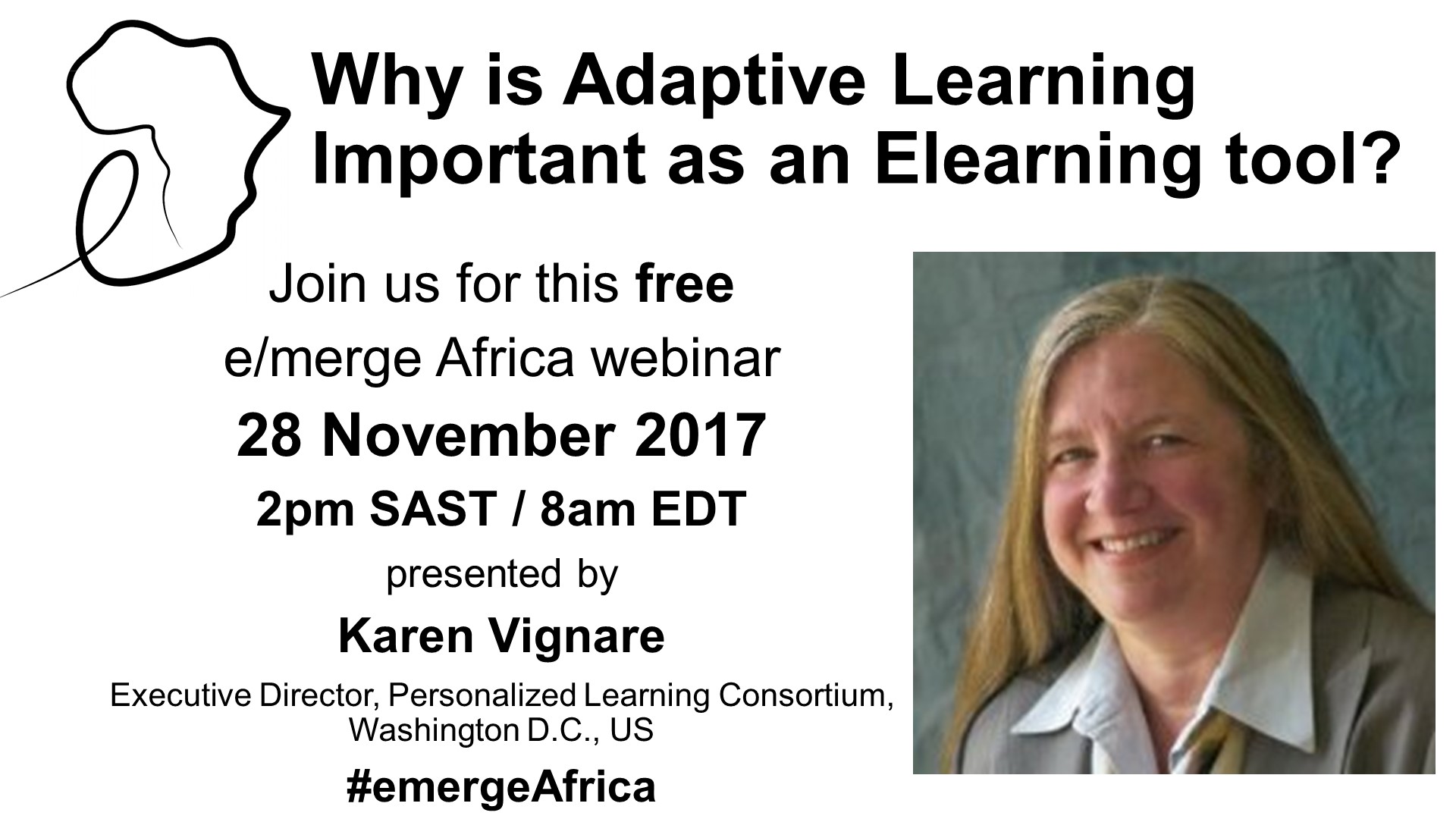
28 November: Why is Adaptive Learning Important as an Elearning tool?

Presenter: Karen Vignare, Ph.D Association of Public and Land-grant Universities (APLU), United States

Time and Date: 28 November 2017, 2pm SAST / 8am EDT

Time converter at worldtimebuddy.com

Adaptive learning has the potential to transform student learning by providing students with self-paced individualized learning experiences. How can we leverage emerging technologies to improve access, success and flexibility within higher education? Throughout the elearning world, faculty and universities are exploring the use of adaptive learning technologies. Adaptive learning can be defined as an approach to creating a personalized learning experience for students. Adaptive learning takes a sophisticated, data-driven, and in some cases, non-linear approach to instruction and remediation, adjusting to a learner’s interactions and demonstrated performance level and subsequently anticipating what types of content and resources learners need at a specific point in time to make progress. Active learning occurs when students are no longer just passive participants in the learning process. Active learning can be as simple as students working in groups in the classroom instead of listening to a lecture.

The combination of adaptive and active has been shown to increase student outcomes. These pedagogical approaches provide faculty with data and insight about student performance. As a result, more faculty are changing the tactics they use in the classroom to be active and make sure all students succeed or achieve mastery sooner.

In this webinar, Karen will share some of the experiences of universities in the USA which are scaling adaptive learning. She will also share some of the early research and collective thinking on the following questions:

  • What are active and adaptive learning?
  • What does it involve?
  • What are some of the benefits for students and lecturers?
  • Will adaptive learning grow in African universities?

Do you have a specific question about active or adaptive learning that you’d like Karen to answer? Please register and submit below

Resources:
How Adaptive Learning Can Make Higher Ed More Customized and Effective (Part 1)
How Adaptive Learning Can Make Higher Ed More Customized and Effective (Part 2)
Lorenzo, G. 2016. Failing Forward With Adaptive Learning in Higher Ed. In EdSurge.

This webinar has ended please refer to the resource page for recording and other resources


Karen Vignare, Ph.D., M.B.A, is a strategic innovator leveraging emerging technologies to improve access, success and flexibility within higher education. As Executive Director, for the Personalized Learning Consortium at the Association of Public and Land-grant Universities, Karen manages a network of universities committed to student success through personalization. She also oversees the adaptive courseware grant providing leadership and support to eight pioneering universities which are scaling adaptive courseware in introductory level courses.
Karen previously served as a Vice Provost, at University of Maryland University College, the largest online public open access institution where she led innovations in adaptive learning, student success and analytics. Previous to that work, she served as Director of Project Planning and Implementation for MSUGlobal at Michigan State University where she helped multiple units leverage emerging technologies in extension, non-credit programs, corporate settings, and research projects. She has published extensively on online learning, analytics, and open educational resources. She has a Ph.D. from Nova Southeastern University and an M.B.A from University of Rochester, William Simon Business School.