
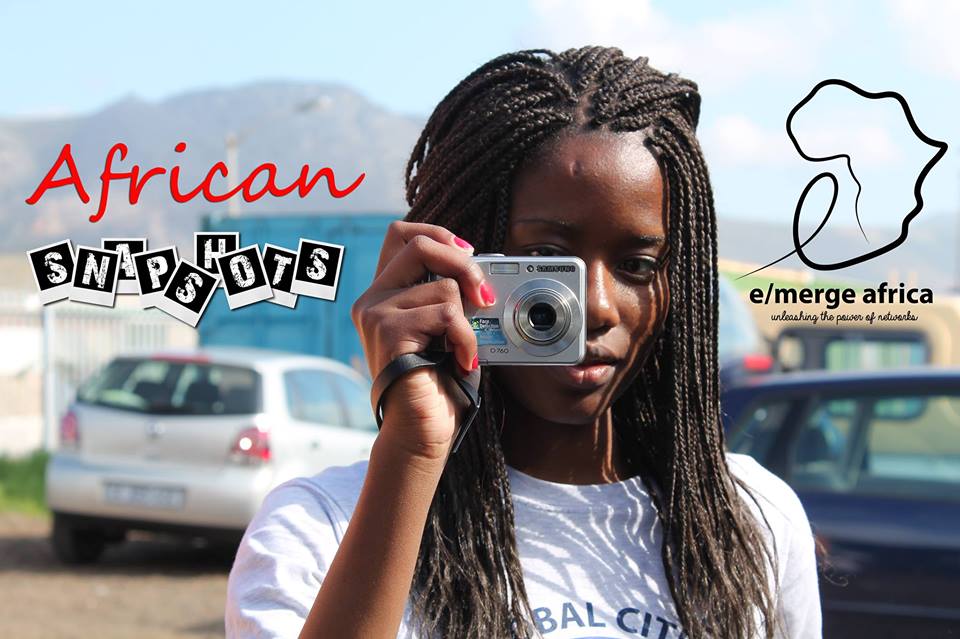
Thank you to all who took part in our small Digital Story event African snapshots: Capturing e-learning in African higher education. During three weeks we received photos on the themes of ‘Loving Technology‘,’Hating Technology‘ and “A Window into eLearning‘. One winner per week was chosen and these three contributions now stand a chance to win the main price a US$25 voucher for Amazon.com. Please help us by voting using this form
In collaboration with South Africa’s first Digital Story Festival, hosted at the Cape Peninsula University of Technology (CPUT) 16 March 2016 (Pre-festival workshops 11, 12 and 14 March) we are presenting this Photo Competition: African snapshots – Capturing e-learning in African higher education together Grab your smart phone, tablet or digital camera and take part!
Description:
An image tells a story. If someone were to take a peek through the door of your classroom for example, what might they see? How does e-learning happen in your context? The aim of this photo competition is to share photos depicting the landscape of e-learning uptake in African higher education. What does this look like ‘on the ground’? How is technology being used to foster learning and teaching relationships across the African continent? What contextual challenges do you face with e-learning in your teaching?
How do I get involved?
Each day/week at midday a new ‘theme’ will be posted to the group. We kick off this event with a Valentine’s Day theme: ‘We love technology’. We also have some trigger questions that might help you with selecting an appropriate photo to share for the various themes. For ‘We love technology’, this trigger question is:
1. e-learning I love because… (it helps me teach or learn better, collaborate with colleagues or students, etc.)
An online seminar will conclude this event where we reflect on what we have learnt about e-Learning in African higher education from the process of collective image capturing.
What do I need to share?
We invite you to share images of e-learning and e-learning use in African higher education. Please tell us (as a comment on your photo):
1. Who took the photo
2. Country & location
3. What story does it tell
Technology must be somewhere in the picture and you are allowed to edit your photos.
How is technology used for learning? Where does e-learning happen? It doesn’t need to be a classroom or computer lab. You can capture a learning experience or interaction with technology that happens anywhere but it must be related to African higher education, capture technology and be related to learning. Once you have uploaded your images and the answers to these three questions, we encourage you to engage further with other members of this group. Please reply to comments from others should they have any questions about your photo. We advise that you have written consent from any persons who are identifiable in your photos and that you have explained the purpose of the photo to them (i.e. they are aware that it will be online and might be used by others in ways you might not anticipate).
When will the competition take place?
The competition will run for three weeks, from the 14th of February 2016 until the 6th of March 2016. Themes will be shared every Sunday (14th, 21st, 28th of February). Weekly winners will be established on the following Monday.
Where will I share these images?
We have created a closed Facebook group for participants in this competition. We will share the link to the group on the e/merge Africa Facebook group and through other networks.
Why is it important to share such images?
Have you ever searched Google images for pictures of e-learning in Africa? Google ‘e-learning in Africa’ and see what happens… Many of the photos we may find are often not taken by African people and might have a Western ‘gaze’. Photos are always selective: what one captures and values in one context might be different in another. Many do not depict everyday realities on the ground. When we narrow down this search to images available for reuse, the results get even smaller; for images of African higher education, even less so. Our aim is to create a collection of African images of e-learning contexts and activities taken by African educators that can be shared after the competition has taken place.
What’s in it for me?
You might want to use this event as a head start for thinking about what photo to submit for the 2016 eLearning Africa photo competition
Photos shared to the group will be used to create a video slideshow that tells a collective narrative or e-learning in African higher education. This video will be screened at e/merge Africa workshops. One of these will be at eLearning Africa 2016.
This video will also be screened and individual photos exhibited at Africa’s first digital storytelling festival taking place in March 2016. Info here:
And we also have some prizes:) Each week will also be a competition where one of the photographers can win an e/merge Africa t-shirt. Top photos over the weeks will also be featured on the e/merge Africa homepage. Number of likes on a picture in the Facebook group will determine the winning picture of the week.
Knowing you have contributed to an online repository of openly licensed images and that you can make use of these images for free in your presentations and other purposes is also a big win.
The event also provides an opportunity to collaborate around, value and discuss the various contexts where e-learning happens within higher education in Africa.
During the process, we also learn about the value of sharing, open licensing, open research, etc.
By adding your photo you agree to the following:
That photos and interactions in the Facebook group can be used for research purposes by e/merge Africa.
Photos uploaded to this group will also be uploaded as a public album on Flickr and licensed under creative commons. Thereby, anyone can use these images for a variety of purposes. Potential uses may include commercial, non-commercial and/or educational, etc. Please be aware of this when taking picture, i.e. ask people in your pictures for permission when taking the picture (if they are recognisable). Learning more about creative commons and open licensing here.
 The Facilitating Online course